Volkswagen workers vote on union in Tennessee — a major test for organized labor
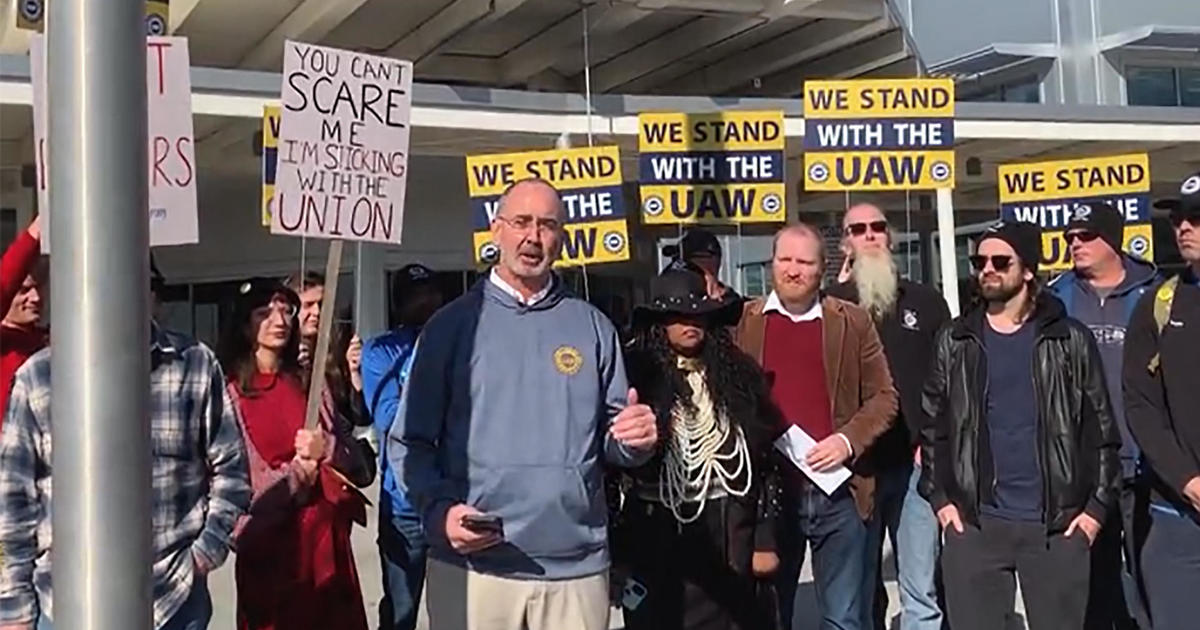
The United Auto Workers is hoping the third time proves the charm in Chattanooga, Tennessee, as the labor group seeks to make inroads in Southern states, where employers and elected officials have long resisted unionization.
As the final ballots are cast Friday by 4,300 Volkswagen workers deciding on whether to join the UAW, expectations are running high among labor advocates that the union will prevail after two failed attempts.
“A lot is riding on what is taking place now and what will be decided tonight,” Harley Shaiken, a professor emeritus at the University of California, Berkeley, told CBS MoneyWatch. “This is a pivotal movement for the workers in Chattanooga, but much more broadly for workers in the South and for organized labor more generally.”
The chances for a UAW win seem high, given that about 70% of the plant’s workers pledged to vote in favor of unionization before it requested the vote, according to the union. Voting that began on Wednesday concludes Friday at 8 p.m. Eastern time, with ballot counting expected to take a few hours.
“We are going to win this, with the support we’ve gotten over the past week from our co-workers, from people who were on the fence,” said Victor Vaughn, an employee at the plant for nearly two years and a member of the organizing committee. “We are very intelligent, hard workers, family-oriented and we care about our jobs. That is what we’re doing throughout the South.”
Job safety and health care costs are two of the primary issues that workers at the plant hope to address, Vaughn added. At the time VW proposed an 11% wage increase late last year, workers were unaware the company planned to hike health insurance premiums 15%, Vaughn said.
“That was a shock to a lot of us,” he said.
The UAW set its sights on organizing foreign automakers after a historic six-week strike last fall against Ford, General Motors and Stellantis led to major wage gains.
“If they can’t organize at Volkswagen, you’d have to question their ability to organize at any of these Southern auto plants,” John Logan, chair of labor and employment studies at San Francisco State University, told CBS MoneyWatch.
A regional foothold?
The UAW for decades has unsuccessfully attempted to organize at auto factories in the South, making progress only at a few heavy truck and bus plants in the region. The vote is the UAW’s third try at the plant, where workers narrowly spurned union membership in both 2014 and 2019. The UAW was also defeated in a 2017 vote at a Nissan plant in Canton, Mississippi.
A UAW win would give the union a key foothold in the region, where organizing usually means fighting not only the company but the entire community, including the political and business establishment, Logan said.
“When we secure our contract with the UAW, I think it is going to open the door for so many other plants, Mercedes-Benz included,” said Vaughn, referencing an upcoming election next month by autoworkers at Mercedes plant in Vance and Woodstock, Alabama.
Earlier in the week, the governors of six states — Alabama, Georgia, Mississippi, South Carolina, Tennessee and Texas — decried the unionization effort, saying it jeopardized jobs.
If the UAW prevails, the Volkswagen factory would be the only unionized foreign commercial carmaker in the U.S. It would also be the first auto plant to join the UAW since its action targeting the Big Three automakers in Detroit.
Boosted by Big Three strike
“Interest in the UAW has been fueled by spectacular gains in the Detroit Three contract talks last year. Almost all 13 of the non-union automakers have boosted wages to diminish interest in organizing and these gains are widely referred to as the ‘UAW bump,’ Shaiken said. “Paradoxically, automakers are confirming the UAW does deliver.”
In the case of Germany’s Volkswagen, which has unionized workers around the globe, the opposition to the UAW’s efforts has been less fierce than those seen with other corporate entities, Logan noted.
In fact, the Chattanooga plant is Volkswagen’s sole facility of about 120 globally that does not have some form of employee representation.
“We respect our workers’ right to a democratic process and to determine who should represent their interests. We fully support an NLRB vote so every team member has a chance to a secret ballot vote on this important decision. Volkswagen is proud of our working environment in Chattanooga that provides some of the best paying jobs in the area,” the company stated.