Define constructive dismissal.
constructive dismissal
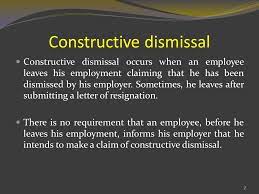
The term constructive dismissal is a common one in employment law. In essence, it refers to an employer who creates intolerable working conditions, forcing the employee to resign. If this occurs, the employee may be entitled to severance pay and employment insurance (EI). However, it can be difficult to recognize constructive dismissal because the actions leading up to it often occur over time and may not appear severe or intolerable in isolation. As a result, it is important to know what to look for so that you can protect your rights as an employee.
The legal test for constructive dismissal is whether a reasonable person in the employee’s shoes would have felt compelled to resign. There are a number of factors that can play a role, such as the deterioration of working conditions, changes to essential terms in an employment contract, demotion or reassignment from a senior position, reducing an employee’s salary, a failure to maintain safe working conditions, and a hostile work environment. A constructive dismissal claim can also be made if the conditions are so intolerable that they cause the employee to suffer mental distress, causing them to suffer from insomnia or other health problems.
Generally, in order to qualify as a constructive dismissal, the employee must have been forced to resign. This means that they must have resigned soon after the unreasonable situation was imposed on them. The resigning employee must also be in a position to find comparable employment. This is a crucial factor as it prevents employers from claiming that the claimant has resigned because they can’t afford to continue their employment.
Define constructive dismissal
It is also essential to understand that the employer must be aware of the intolerable conditions in order for them to be considered a constructive termination. It is important for an employer to be aware of the employee’s working conditions so that they can correct them if necessary. If the employer was unaware of the intolerable working conditions, it wouldn’t be fair to consider it a constructive dismissal.
A breach of an explicit term is much easier to prove than a breach of an implied term, although any behaviour that destroys the trust and confidence between the employer and employee without good reason will likely meet the criteria for a constructive dismissal claim. This includes, but is not limited to, cancelling benefits, imposing an arbitrary pay decrease, eliminating defined job responsibilities, or failing to maintain safe working conditions.
The notice period required after a constructive dismissal is based on the minimum set out in the Employment Standards Act (ESA) but can be influenced by the following: -Length of Service: Long term employees are typically entitled to a longer reasonable notice period than short term employees. -Type of Role: The more specialized or high level the role is, the less comparable employment opportunities are, and therefore the length of notice needed will increase accordingly. -Availability of Similar Employment: It is difficult to find similar jobs at the same or higher level than one’s previous role, therefore, it can take longer for a Vice President to find a new job than it would for a fast food cashier.